
Beyond Hydration: Water’s Extraordinary Role in Health
We are constantly told to drink more water – six to eight glasses a day, or half your body weight in ounces, more if you exercise. Natural health advocates, physicians, and fitness experts all agree on one thing: water is essential.
Astrobiologists even search for water on other planets as a prerequisite for “life as we know it.”
But why is water so central to life?
The answer goes far beyond hydration.
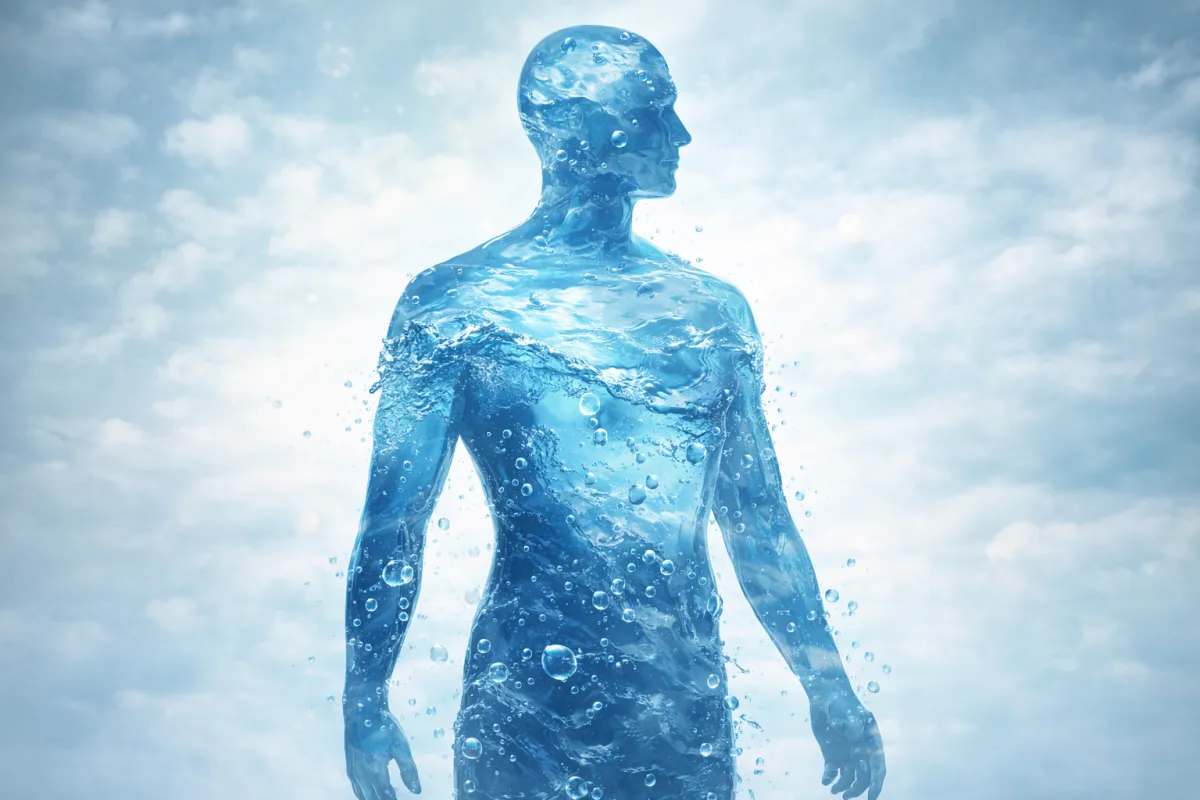
You Are (Almost Entirely) Water
By weight, the human body is roughly 60-70% water. But by molecular count, water makes up closer to 99% of the molecules in the body. Water molecules are small and light, so they contribute less to mass than proteins, fats, and minerals – but in sheer number, they dominate.
From a molecular perspective, you are not a biochemical machine using water. You are a water-based system within which biochemistry occurs.
Given that reality, it would make sense for biology and medicine to place enormous emphasis on understanding water’s properties. Yet for much of modern science, water has been treated as a passive background – a solvent, a carrier, a neutral medium.
That assumption turns out to be wrong.
Water’s Many “Anomalies”
Water behaves unlike almost any other liquid on Earth. Physicists have cataloged dozens of anomalous properties of water, including that:
Ice floats instead of sinking
Water reaches maximum density at 4°C, not at freezing
It has unusually high surface tension
It exhibits strong capillary action, allowing fluids to move through extremely narrow channels
It forms menisci and appears to “climb” surfaces
Without these properties, life could not exist. Blood would not move efficiently. Nutrients would not distribute properly. Cells could not maintain their internal organization.
These anomalies point to something deeper – water has structure.
The Fourth Phase of Water
This insight of water having structure was developed most clearly by Gerald Pollack, Professor of Bioengineering at the University of Washington and author of The Fourth Phase of Water.
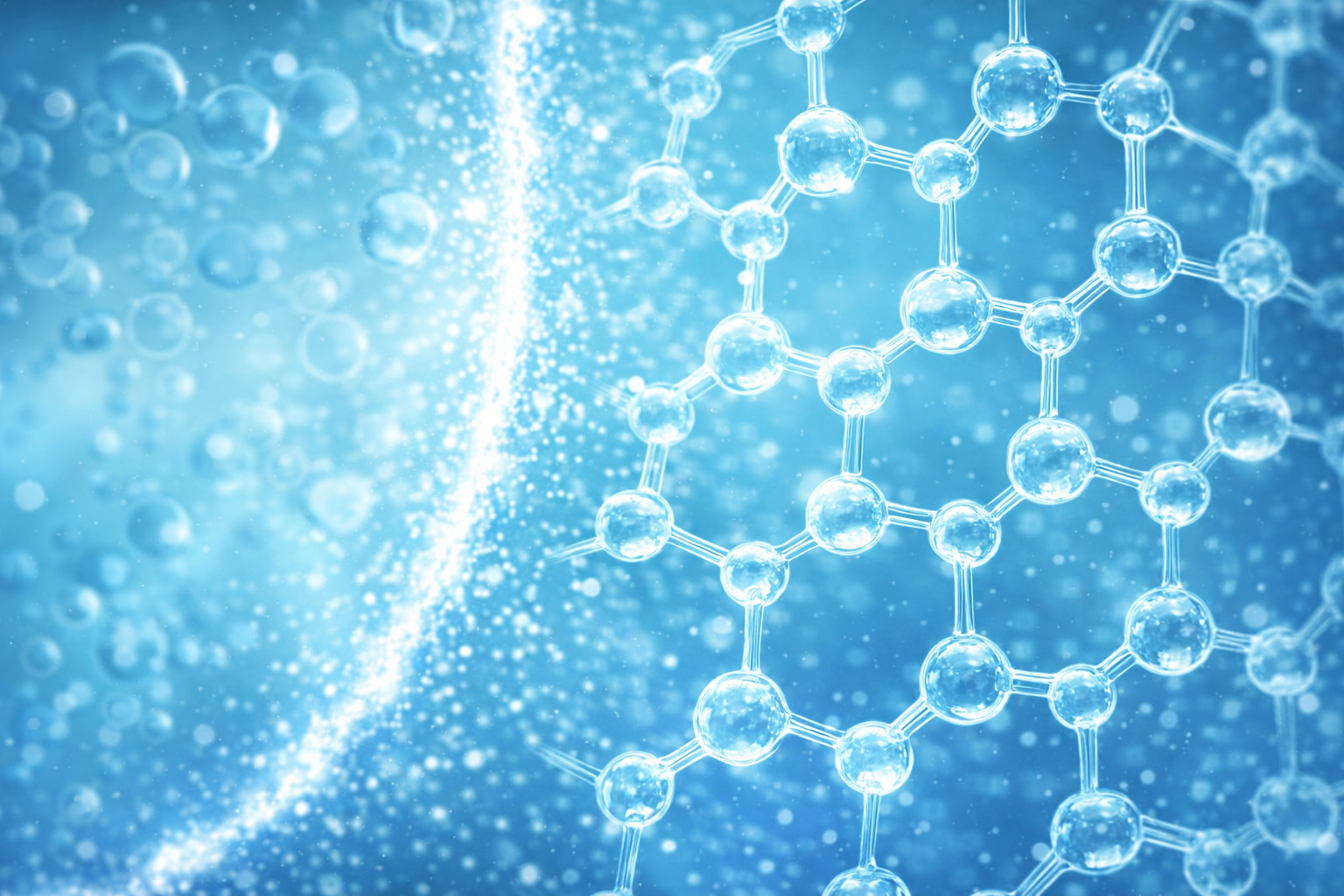
Pollack demonstrated that when water contacts hydrophilic (water-loving) surfaces – such as cell membranes, proteins, DNA, and many minerals – it organizes itself into a gel-like, structured state distinct from ordinary liquid water.
He called this region Exclusion Zone (EZ) water, because it excludes particles, solutes, and debris, pushing them into the surrounding “bulk” water.
This is not a metaphor. The exclusion can be seen directly under a microscope.
What’s more, EZ water behaves differently:
It is more ordered and stable
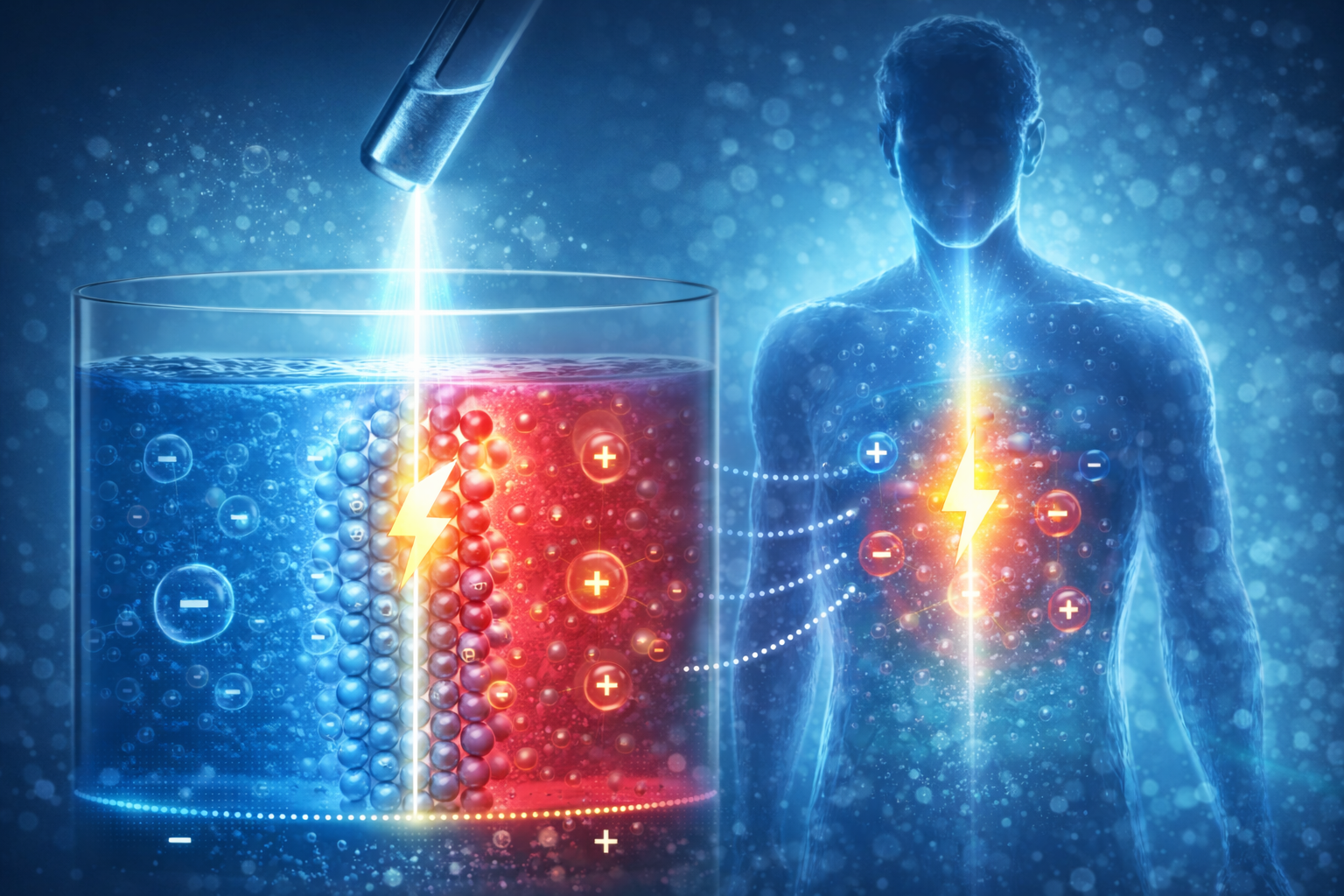
It carries a negative charge, while the surrounding bulk water becomes positively charged
It stores energy and maintains long-range order
Some researchers describe its repeating structure as H₃O₂, showcasing its layered, lattice-like organization.
The key point is this: water near biological surfaces is not ordinary water.
Water as a Living Battery
The charge separation between EZ water and bulk water creates electrical potential – in effect, a biological battery.
This matters because life is largely electrical.
Cells, nerves, muscles, and tissues all depend on voltage gradients. The conventional explanation places nearly all responsibility on ion pumps and electrolyte gradients across membranes. Those mechanisms clearly exist and are essential.
But measurements inside cells revealed something surprising: electric fields far stronger than expected, far beyond what simple ion diffusion alone should produce. Structured water provides a missing piece to this puzzle.
According to Pollack’s work, EZ water contributes substantially to these electric fields, helping explain:
Cellular voltage
Electrical coherence inside tissues
The persistence of bioelectric activity even when cells are damaged or partially disrupted
EZ formation increases in the presence of infrared light and heat – both of which are continuously produced by living organisms and abundantly supplied by sunlight – helping explain its persistence throughout the body and the value of exposure to the sun.
In this sense, water can harvest environmental energy in a way that supports the body’s electrical activity.
Water, Flow, and the Body
Pollack’s experiments also demonstrated that structured water lining narrow tubes can drive fluid flow without mechanical pumping. This has implications for understanding:
Capillary circulation
Microvascular flow
How blood moves through vast networks of vessels with minimal pressure
The heart remains essential, but it may not be doing all the work we once assumed. Water itself participates in circulation.
Beyond Energy: Water and Information
Water’s role in circulation, electrical activity, and energy generation already sets it apart from any other biological medium. But energy alone does not explain life.
Living systems are not just powered – they are coordinated. Billions of processes occur simultaneously, in the right place, at the right time. That coordination requires accurate signaling and regulation, not merely fuel.
This raises a deeper and more controversial question: does water play a role not only in energy, but in information?
Order, Coherence, and Pattern
In physics, order does not mean rigidity. It means reduced randomness and increased coherence.
Ordered systems can support stable patterns. Disordered systems cannot.
Water is unusual precisely because it can move fluidly while still forming cooperative networks through hydrogen bonding. These networks constantly form, dissolve, and reform, yet they behave collectively rather than randomly.
This makes water exceptionally sensitive to:
Electromagnetic fields
Vibrational inputs
Boundary conditions and surfaces
Environmental signals such as sound, light, and charge
Importantly, none of this requires water to “freeze” into a permanent structure. Water can remain dynamic while still retaining the influence of a coherent pattern introduced during imprinting.
A Brief History of a Controversial Idea
Interest in water’s informational behavior did not arise from theory alone, but from experimental observation.
In the late 20th century, immunologist Jacques Benveniste reported biological effects from solutions diluted beyond the point where any physical molecules of the original substance should remain. The work was controversial, heavily scrutinized, and ultimately rejected by mainstream biology.
What is often overlooked, though, is that the dispute centered less on whether effects were observed and more on how they were interpreted.
Benveniste proposed that water retained some form of information about substances once dissolved in it. While his interpretation was not accepted, the observations themselves proved difficult to dismiss.
Decades later, Nobel Prize-winning virologist Luc Montagnier explored related questions from a different angle. His experiments suggested that highly diluted DNA solutions were associated with measurable low-frequency electromagnetic signals, and that these signals could be recorded and transmitted into water.
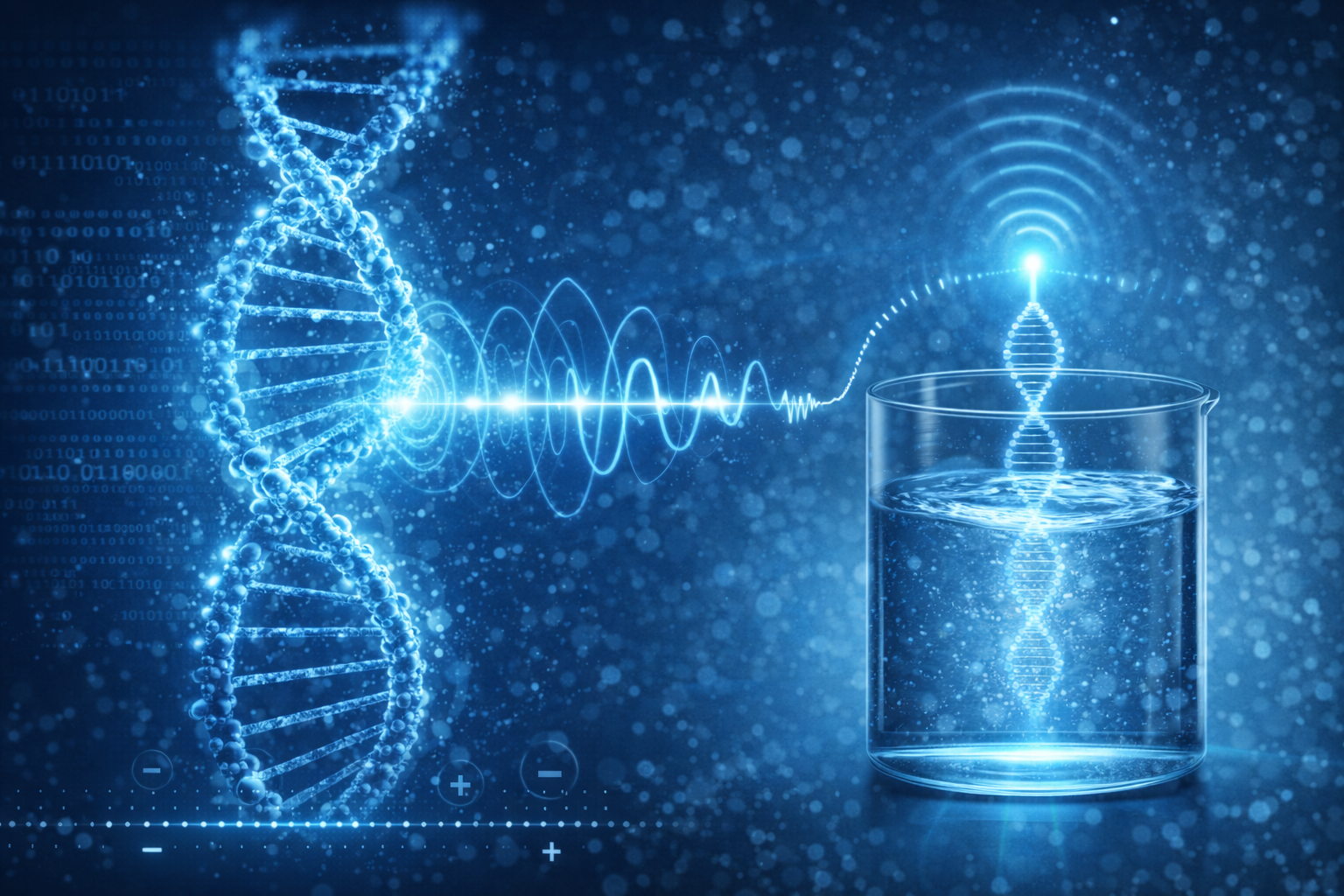
Montagnier hypothesized that water acted as a carrier or mediator of these signals. His conclusions remain controversial and are not part of accepted molecular biology, but he stood by his findings publicly.
What matters for our purposes is not whether every interpretation was correct, but that water repeatedly demonstrated sensitivity to non-chemical influences and was able to carry those influences into biological systems, producing measurable effects under controlled conditions.
What “Water Memory” Really Means
Discussions of “water memory” often fail because the concept is framed too narrowly, as if water must behave like a permanent molecular recording medium. That is not what is being proposed here.
Water memory doesn’t mean that water gels or freezes into a rigid structure, nor that it stores information in a static, unchanging form. Water remains dynamic, mobile, and responsive to its environment. At the same time, experimental work shows that water can retain the influence of prior energetic or electromagnetic inputs well beyond the moment of exposure.
In other words, water does not merely react and forget. It can be imprinted – influenced by a sufficiently strong, coherent signal – in a way that persists over time, even after the original stimulus is removed.
Research has shown that water’s ability to be imprinted depends on environmental conditions. In particular, experiments have demonstrated that when water is isolated from ambient electromagnetic fields – such as within a Faraday cage – imprinting effects are dramatically reduced or absent. This suggests that weak, large-scale fields, including those naturally present in the environment, normally participate in enabling imprinting to occur.
From this perspective, imprinting is not an exotic anomaly, but a natural consequence of water’s interaction with fields and charge.
Stronger, more coherent inputs appear capable of producing more stable and persistent imprints. This is consistent with the idea that electrical charge, electromagnetic coherence, and boundary conditions influence how long an imprint remains influential before being overwritten by background noise.
The imprint represents a residual organization or bias within the water’s collective behavior – one that can later interact with biological systems and influence regulatory processes.
Where Structure Fits In
As we’ve discussed, structured water, such as the exclusion-zone (EZ) water described by Gerald Pollack, plays a clear and important role in biology by supporting:
Charge separation
Electrical coherence
Energy availability
Fluid movement
These effects are well grounded in experimental observation.
But more than that, structure may also play a supportive role in informational processes – not by acting as a rigid memory store, but by improving coherence during the imprinting or transfer of patterns.
In other words, structure can:
Increase signal-to-noise
Stabilize coherence while a signal is present
Improve repeatability and fidelity
So structure is not required for information to exist, nor does information depend on water holding a fixed physical shape, yet the use of structured water is one more tool in supporting a long-lasting imprint, allowing water to influence biology.
From Observation to Application
Energy4Life’s approach builds on this layered understanding of water.
Water is not just a solvent.
It is not just a fuel source.
And it is not a static memory device.
Water is a living medium – one that participates in energy generation, electrical organization, and informational signaling throughout the body-field.
Structured water is used in the imprinting process of Infoceuticals because it enhances coherence at the moment information is introduced. And this is coupled with a 10,000 volt electrostatic charge to ensure a stable imprint of information that is not overwritten by the environment. In this way, we effectively transfer a coherent pattern into an Infoceutical that the body can recognize and respond to.
The body is the system that integrates and maintains the signal. The water is the messenger.
Why This Matters
Modern biology has been extraordinarily successful at describing chemical mechanisms. But chemistry alone cannot fully explain coordination, timing, and regulation across complex living systems.
Water sits at the intersection of physics, biology, and information.
Once water is understood not as a passive background, but as an active participant in energy and communication, many longstanding puzzles begin to make sense.
This perspective does not replace conventional biology. It completes it. And it opens the door to approaches like Infoceuticals that support health by restoring coherence, communication, and organization at the most fundamental level possible.
