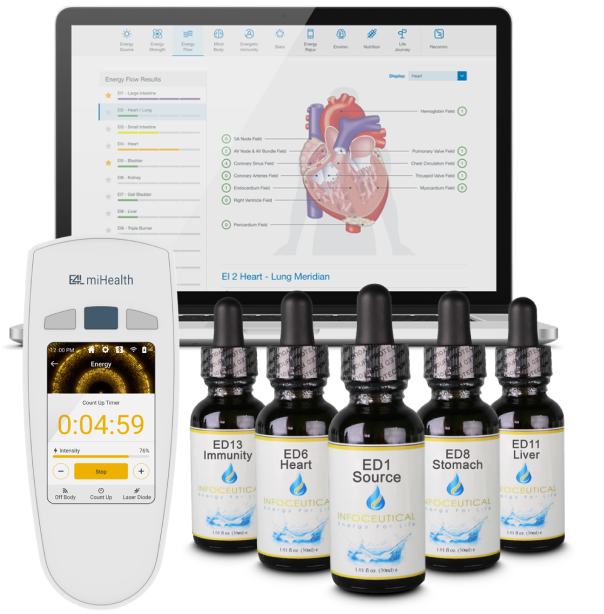
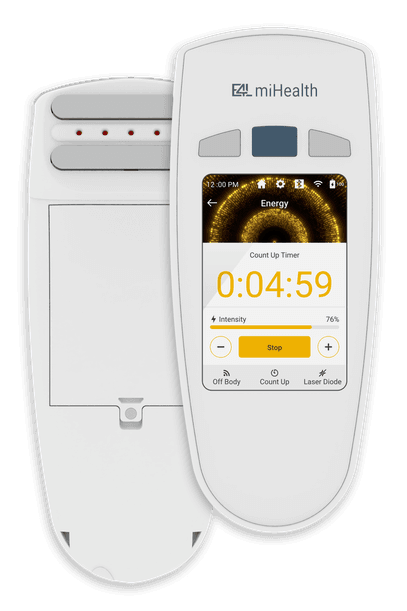
A handheld you move over the skin. It reads the tissue as it goes, finds where the charge has dropped and puts it back, with the dose set by your client's own body. In an outcome study of 251 people, 88% reported a benefit at their first session.
Thirty minutes, one to one. A live scan, the device, and how it fits into your practice.
Information tells the body what to do. Tissue that has run flat, strained or guarded for years, hasn't got the charge to do it.
In the Energy 4 Life model, Vitality = Information × Voltage ÷ Resistance. Infoceuticals (the imprinted drops your clients take at home) restore the information. miHealth is the Voltage tool. It puts the charge back, locally, in the room, in the session your client is sitting in.
Give the cells their charge back and the body's own repair has something to run on. The device does the nudge. The body does the rest.
miHealth · the video goes here
Three things at once, as you move it across the skin. Your client's own tissue sets the dose.
Glide it over the skin and it measures the skin's electrical response as it goes. Where the charge has dropped, the reading changes and the device shows you. So you know where to work.
Microcurrent, red light and pulsed magnetic energy go in, and the waveform keeps changing with the skin's response. Your client's body steers the output. When an area has had enough, the device tells you and you move on.
The signal carries information from the body-field map Harry and Peter Fraser spent decades building, around 440 parts, functions and tissues. So the energy arrives with instructions for how that spot is meant to run.
Direct microcurrent with feedback, red light between the electrodes. The mode for tight or guarded tissue, and for finding it in the first place.
A dedicated PEMF coil delivers the same information as a field. For sensitive areas, for the calming programs, and for clients who like to ease in.
A session takes 20 to 30 minutes and usually sits inside a visit.
Each has its own research base. miHealth runs all four on one signal.
A current close to the level cells run on, shaped by the skin's response moment to moment. It works at the nerve endings and fascia, a few centimeters in, which is a different job from a TENS unit driving muscle.
A dedicated coil delivers gentle pulses of magnetic energy to the tissue. On the body, or broadcast above it.
Red light absorbed at the skin, where the nerve endings sit (and, in the Chinese-medicine tradition, the acupuncture points). It supports microcirculation and everyday recovery.
Body-field information layered onto the current, the light and the field together. This is the part that makes it ours.
| Bought separately | Typical cost |
|---|---|
| A clinical PEMF system | several thousand dollars |
| A clinical red-light unit | several thousand dollars |
| An interactive microcurrent system | several thousand dollars |
| Body-field information on the signal | only here |
| All four in one handheld: miHealth | one device |
Comparison figures are general market estimates for standalone professional equipment and vary by brand and model. A serious version of each typically runs to $15,000 to $20,000 across three or four machines. Most practitioners find a miHealth pays for itself within about 20 sessions.

By the time Peter's work had given me most of my energy back, I could get out and live again. But I had a fractured spine, and I realized I was still using up an awful lot of energy every day just because of all that injured tissue.
If you're just delivering information to the body, it gets the right instructions. But if you're full of scar tissue and old injuries, that's a different level of problem, and information alone doesn't solve it. So I wanted to make a device you could just use on yourself. It took about three years. We took the biofeedback microcurrent that came out of the Russian space program, added a pulsed magnetic field and red light, and put the information from our map of the body field onto every signal.
It finds where your charge has dropped and puts energy back into the tissue. Once the cells have charge, the body heals itself. That's the whole idea, and I still use mine most weeks.
Harry Massey · founder, Energy 4 Life · the story is in the film
miHealth works on its own. You read the tissue by hand and work from what the client tells you. Add BWS, our practitioner scan, and it becomes precise.

Twenty to thirty minutes on the areas the scan points to, on the skin or just above it. Clients describe a light tingle or warmth, then feeling looser and calmer. In the outcome study, 88% felt a benefit at the first session and 93% after the second. That's what turns a consultation into a course of care.
The scan detects. Infoceuticals correct the information at home and miHealth corrects the charge in the room. Between visits your client's app carries the protocol, with reminders in your name and a rescan every four weeks.
Most practitioners find the device pays for itself within about 20 sessions. Their clients' Infoceutical protocol is drop-shipped by E4L, and what clients order through the app earns you 35% while you're guiding them. Clients who want a miHealth at home are referred to our team, and your affiliate commission applies.
Each with its design and sample size, so you can weigh it the way you'd weigh anything else.
In a self-reported outcome study of 251 people (367 data points), 88% reported a benefit from their first miHealth session and 93% after the second. Among those with long-standing concerns, 85% reported an immediate positive effect.
In Professor Hemal Patel's lab at UC San Diego School of Medicine, living heart cells receiving the information Infoceuticals carry showed about 37% less oxidative stress, higher mitochondrial reserve and 1,139 genes changed in expression. Part of the work used a miniature imprinter, a device-delivered form of that information. A cell study. Ranaweera et al., EXPLORE 2025.
The biofeedback microcurrent at miHealth's core is interactive neurostimulation, developed for the Russian space program and carried forward in the SCENAR and InterX devices. Dr Zulia Frost, who brought it to the West, works with miHealth today.
"In one session, in about eight minutes, he gave me so much relief in my back, I couldn't believe what happened. I literally asked him for a job on the spot."
Brian Gilbranson · co-founder, SportsIQ · from Beyond Medicine
"When I came across miHealth, it felt like the next step in the development of this technology… In my view it does everything faster, which matters a lot when you have a busy practice."
Dr Zulia Frost · medical doctor, bioelectric therapy specialist · from Beyond Medicine
"What's hard to understand is it really doesn't do anything except provide the signal. The body does everything else."
Dr David Matthews · craniofacial reconstructive plastic surgeon
Personal experiences, in their own words. Quotes are excerpts.
One to one with our practitioner team. A live demonstration, and your questions answered.
We run a real scan and walk through the report it produces, and the miHealth functions it writes from it.
Where a session sits in a visit, on body and off body, home use for clients, and the training that comes with it.
What practitioners charge for a session, how the numbers work for you, and the simplest way to start. Then decide at your own pace.
Pick a time that suits you.
Each of those does one thing, with one fixed signal and no feedback. miHealth reads the skin's response in real time and changes its waveform as the body responds, works a few centimeters into the skin where the nerve endings and fascia are, runs microcurrent, PEMF and red light together, and carries the body field's information on the signal. Four modalities, one device, and the body steers it.
miHealth works on its own: you read the tissue by hand and work from what the client tells you. With BWS, the scan names the organ or system asking for support and writes the miHealth functions for you, placement and program, in priority order. Most practitioners run both, and the call shows you how they fit.
A session takes 20 to 30 minutes and usually sits inside a visit. The device is guided: glide it over the area and it finds the spot. Training covers the program families, on-body and off-body work and how to read the feedback. It's live and recorded, so you learn at your pace and can train your staff too. If you go on to BWS certification, the Quick Start Lessons take about two hours and full certification around twenty. Dr Zulia Frost runs advanced webinars on approaches for different client presentations.
Yes. The home programs are simple and guided, and off-body mode makes it easy to use over clothes. Some practitioners lend a device to a client for a few weeks; some clients buy their own. Our team handles client sales, and your affiliate commission applies.
Yes. miHealth is non-invasive and drug-free, and the intensity is always adjustable. Your client's own skin sets the dose, and the device tells you when an area has had enough.
miHealth is sold as a general-wellness device that supports healthy energy, recovery, mobility and relaxation. We'll cover the regulatory position for your region on the call.
That's the call. We'll go through how miHealth fits into your practice, what it costs, and the simplest way to start, so the number you hear is the right one for you. It comes with a 30-day money-back guarantee, and most practitioners find it pays for itself within about 20 sessions.
Thirty minutes, a live scan, and the device in context. Over two decades of bioenergetic research and a global practitioner network behind it.
miHealth is a general-wellness device and not a medical device. It supports healthy energy, recovery, mobility and relaxation, and does not diagnose, treat, cure, or prevent any disease. BWS is an energetic assessment, not a medical diagnosis. Study results are stated as each study reported them.